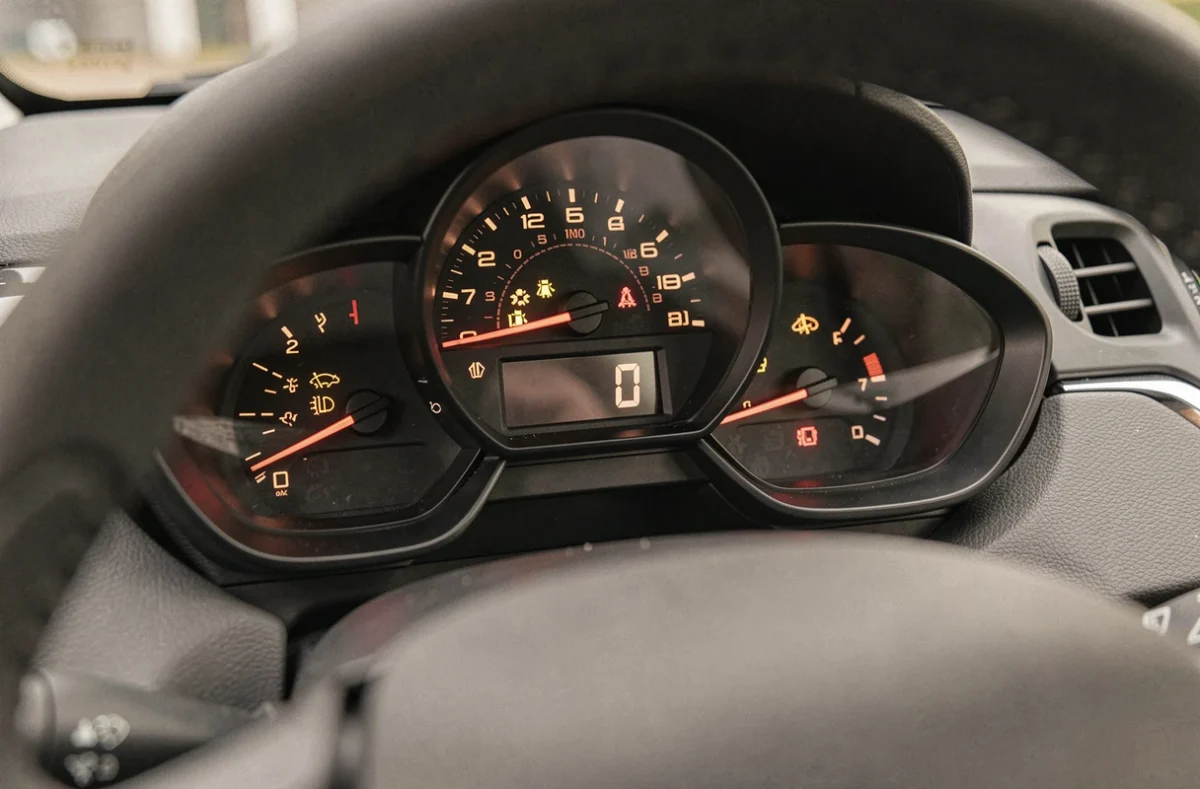
On a Peugeot 208 petrol, the dashboard communicates through a system of warning lights, each corresponding to a specific circuit or sensor of the vehicle. Their role is to indicate a normal operating state, an anomaly to monitor, or an immediate mechanical danger. Understanding what each light conveys, and especially what it does not say once turned off, helps avoid costly diagnostic errors.
Fixed or flashing engine light on Peugeot 208: two distinct levels of severity
The orange engine light is the one that generates the most confusion. On recent 208s, the manual clearly distinguishes two behaviors. A fixed engine light indicates an emissions fault that needs to be diagnosed quickly, but not urgently. The vehicle can drive at a moderate speed to a workshop.
A flashing engine light radically changes the situation. The flashing indicates a risk to the catalytic converter, a component whose replacement represents a significant expense. In this case, immediately reduce engine load and consult a workshop without delay is the course of action. Therefore, the color alone is not enough: the rhythm of the light and the message displayed on the central screen are as important as the hue.
For a more comprehensive explanation of the dashboard lights on Peugeot 208 petrol, each pictogram is associated with a specific circuit of the powertrain or chassis.
Red lights on Peugeot 208 petrol: the three alerts that require stopping
Not all red lights indicate the same mechanical urgency. Three of them, on a petrol 208, require the engine to be turned off as soon as traffic conditions allow.

- Engine oil pressure: this light (symbol of an oil can) comes on when the pressure drops below a critical threshold. Driving in this state causes accelerated wear of the bearings and can destroy the engine in a few kilometers. Checking the oil level on the dipstick is the first reflex, but if the level is correct and the light persists, the problem lies with the oil pump or the sensor.
- Coolant temperature: on PureTech engines, untreated overheating quickly warps the cylinder head. Stop the vehicle, let the engine cool without opening the expansion tank cap (risk of burns), then check the coolant level.
- Braking system: a red brake light associated with the STOP symbol indicates either insufficient brake fluid level or a fault in the hydraulic circuit. Continuing to drive under these conditions compromises the vehicle’s stopping ability.
The other red lights (seatbelt, open door, battery) indicate states that do not directly threaten the engine but require immediate action for the safety of the occupants or electrical reliability.
PureTech engine and specific lights: what the belt can trigger
The PureTech 1.0 and 1.2 engines, widely used in the petrol 208 range, have a particularity. On certain generations, debris from the timing belt can migrate into the lubrication circuit and disrupt the operation of the oil pump. Therefore, the illumination of the oil pressure light on these engines should not be treated as a simple generic alert.
An oil pressure light on PureTech can mask a belt problem. The diagnosis involves inspecting the chain or belt (depending on the generation), checking the oil pan, and sometimes analyzing residues in the filter. An extension of coverage has been announced by the manufacturer for certain PureTech engines, subject to conditions related to the VIN, maintenance history, and the nature of the failure.
Light off on a used 208: why OBD reading remains necessary
A dashboard that is off at startup, with no lights illuminated, is reassuring. However, this absence of visual alert does not guarantee anything about the actual condition of the vehicle. An off light does not prove that no fault is recorded in the ECU.
The engine control unit (ECU) stores fault codes even after the light has disappeared. An intermittent fault, for example, a momentary misfire, can turn off the engine light after a few driving cycles without recurrence. The code, however, remains stored. Only a reading via an OBD (On-Board Diagnostics) port allows these stored codes to be read.
Before purchasing a used Peugeot 208 petrol, three checks complement the visual examination of the dashboard:
- Request a complete OBD reading, not just active codes but also historical codes and freeze frame data that indicate the conditions under which the fault occurred.
- Check with the Peugeot network if any recall campaigns or warranty extensions are applicable to the vehicle’s VIN, especially for PureTech engines.
- Verify the consistency between the displayed mileage and the history of interventions: a recent clearing of fault codes just before the sale is a warning sign.
The distinction between a fault that has been truly resolved and one that has simply been erased is a point that many buyers overlook. A cleared code without repair will reappear after a few hundred kilometers. A code absent from the history after a documented intervention is, on the other hand, a sign of proper treatment.
Orange lights on 208 petrol: to drive or to stop
Orange lights generally allow for the continuation of the journey, but not under any conditions. The pollution alert light, for example, sometimes limits engine power through a degraded mode. The vehicle drives, but with reduced performance and possible overconsumption.
The orange battery light, distinct from the red light, can indicate a charging fault without immediate failure. On petrol 208s, it is often related to the alternator or voltage regulator. Ignoring this alert for several days risks draining the battery and causing a no-start situation.
The most reliable reflex in response to an orange light is to read the supplementary message on the combined display. The pictogram alone is ambiguous; the text message specifies the nature of the fault and the level of urgency. On the 208 II, these messages guide towards a stop, a level check, or simply scheduling a workshop appointment.
The dashboard of a petrol 208 provides reliable information as long as one does not limit oneself to the color of the lights. The rhythm (fixed or flashing), the message displayed, and especially the data stored in the ECU form a coherent whole. Ignoring any of these elements is like reading a sentence while skipping half the words.