A French person applying in Madrid or Barcelona with the same CV they would send to Lyon is wasting time. The Spanish job market operates with its own codes, local collective agreements, and platforms that candidates from France often overlook. Before looking for job offers in Spain, it is beneficial to understand what concretely changes compared to a job search in France.
Collective Agreement: The Salary Parameter That French Candidates Overlook
In Spain, the salary displayed in a job advertisement tells only part of the story. The convenio colectivo (collective agreement) applicable to the sector or province may set pay scales, mandatory bonuses, and contract termination conditions that bind the employer, even if the offer does not mention them.
For a French candidate, the useful approach is to identify the convenio that corresponds to the targeted position before negotiating. It can be found on the Boletín Oficial del Estado website or through the Spanish public employment service (SEPE). Comparing the proposed salary with the minimum of the convenio helps to spot undervalued offers, which are common in tourism or hospitality.
When searching for job offers in Spain for French speakers, cross-referencing each advertisement with the applicable convenio provides a real advantage over candidates who settle for the gross amount displayed.
Employment Contract in Spain: Types and Common Pitfalls for a French Candidate
Spanish labor law distinguishes several types of contracts, the implications of which differ significantly from what is known in France. The indefinido contract (permanent contract) remains the sought-after norm, but many employers initially offer a contrato temporal, governed by strict maximum durations.

Since recent reforms, temporary contracts are more regulated. An employer using a fixed-term contract must justify a specific reason (replacement, occasional increase in activity). Non-compliance with these rules can lead to automatic reclassification as a permanent contract.
Points of Caution Before Signing
- Check the professional category mentioned in the contract: it determines the applicable convenio and thus the guaranteed minimum salary, bonuses, and vacation days
- Verify the probation period (periodo de prueba), which varies according to the convenio but cannot exceed six months for qualified technicians or two months for other employees in most cases
- Ensure that the contract specifies the exact workplace, especially if the position involves partial remote work from France (see next section)
A contract signed without checking the convenio can cost several hundred euros per month in missed salary, with no simple recourse once the probation period has passed.
Remote Work from France for a Spanish Company: What No One Clarifies in the Advertisement
Accepting a position in Barcelona while negotiating two days a week from Perpignan seems logistically simple. However, from a tax and social security perspective, it is a minefield.
There is no derogatory remote work regime negotiated between France and Spain. The days worked physically from France must be examined in light of the ordinary rules of taxation and social security. Specifically, beyond a certain volume of days worked remotely from France, the employee may switch to the French social security system, which creates contribution obligations for the Spanish employer.
Before accepting a hybrid position, clarify in writing with the company the geographical distribution of workdays. Large French companies established in Spain generally manage this issue in advance, but Spanish SMEs do not always think about it.
Spanish Job Market: Reading the Numbers with Perspective
The Bank of Spain reports that the social security affiliation data for the third quarter of 2026 is difficult to interpret, due to a regularization of immigrant individuals, some of whom were already working. The institution also anticipates a slowdown in job growth after 2025.
For a French candidate, this observation advocates for a targeted approach. Rather than relying on headlines about Spanish growth, check the demand in your specific profession and in the targeted city. Madrid and Barcelona concentrate the majority of French-speaking positions, but cities like Valencia or Malaga are developing specific activity hubs (tech, shared services).
Where to Search Effectively
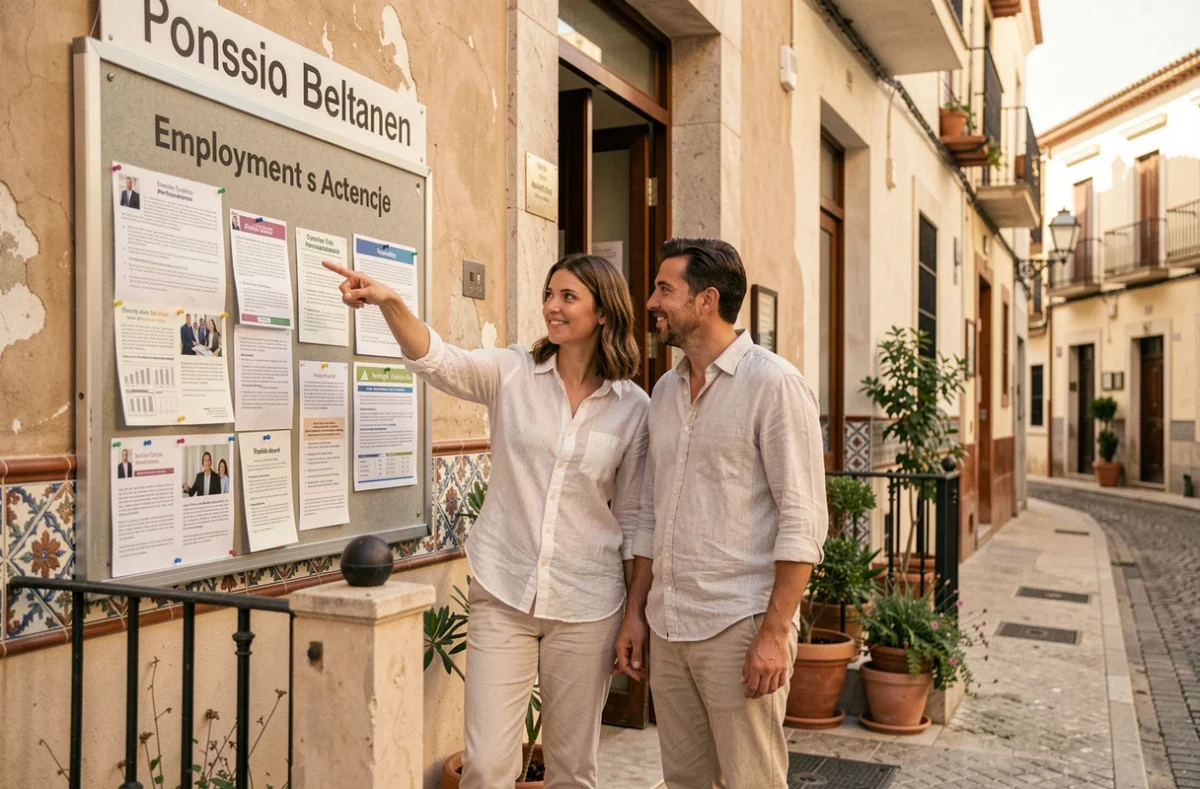
- The EURES portal, managed by the European Commission, lists cross-border offers and positions open to European candidates throughout Spain
- InfoJobs and LinkedIn Spain remain the two most widely used generalist platforms by local recruiters
- Websites specializing in French-speaking jobs in Spain aggregate positions where proficiency in French is a recruitment criterion, often in customer service, sales, or digital marketing
- The Franco-Spanish chambers of commerce regularly publish job listings from French companies established locally
Adapting Your CV to the Spanish Format: What Really Changes
The Spanish CV follows different conventions from the French CV. A photo remains common. The “datos personales” section often includes the date of birth and nationality, two elements that are omitted in France.
The most underestimated point concerns the translation of diplomas. The Spanish education system does not automatically recognize French equivalences. For qualified positions, mention the original diploma with its translation and, if possible, the correspondence in the Marco Español de Cualificaciones.
On the language side, a B2 level in Spanish is sufficient for most French-speaking positions. For positions in Spanish companies without a French-speaking component, a C1 level becomes the expected norm. Mentioning a certified DELE or SIELE level enhances the credibility of the CV with local recruiters.
The Spanish job market rewards candidates who adapt their approach to the local context. Checking the convenio, clarifying the framework for cross-border remote work, and targeting cities where demand matches one’s profession are three concrete actions that separate an effective application from a mass submission without feedback.