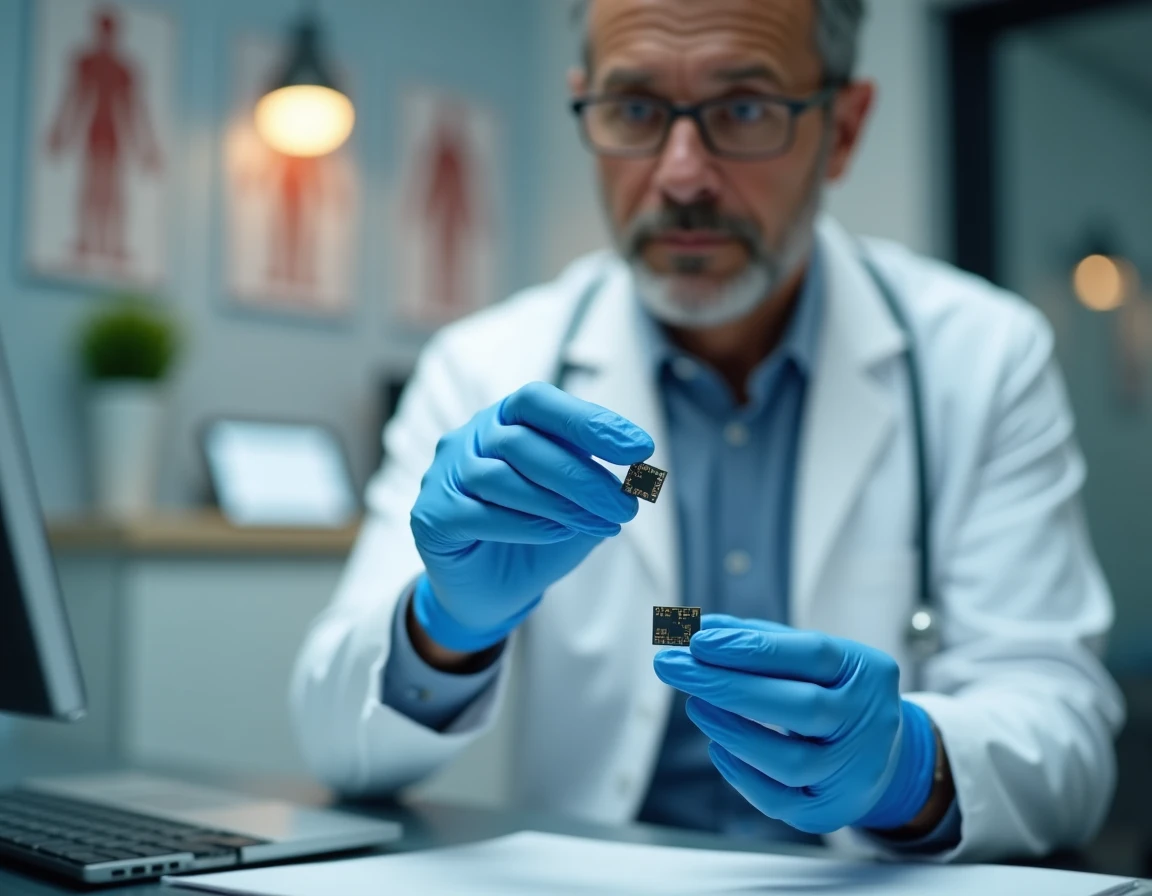
A microchip implanted under human skin does not contain an autonomous GPS module. Current subcutaneous chips use RFID or NFC technology, powered by the electromagnetic field of an external reader. They store an identifier or data in a memory of a few hundred bits, without emitting a continuous location signal.
The term “GPS chip” applied to a human implant is therefore a misuse of language, but it is indeed under this name that the legal question arises in France.
RFID and NFC Technology: What a Subcutaneous Implant Actually Does

The confusion between RFID chips and GPS trackers fuels most fantasies surrounding human implantation. A passive RFID chip has no battery. It only activates when in close proximity to a compatible reader, within a range of a few centimeters to a few meters depending on the frequency used.
In practice, these implants are used to unlock a door, store a digital identifier, or, in some Scandinavian countries, replace a transport ticket. No commercially available subcutaneous implant currently allows for real-time geolocation of a person as a GPS tracker fixed to a vehicle would.
This technical distinction has direct legal consequences. The legal framework applicable to a subcutaneous GPS chip for humans depends on what the device actually does: store an identifier (RFID regime) or track a person’s movements (geolocation regime). France does not have a single text that covers both situations, creating an apparent gap that several legal regimes fill piecemeal.
GDPR and Labor Code: Legal Barriers in France

No French law explicitly prohibits the implantation of a microchip in the human body. No law specifically authorizes it either. The applicable law results from a layering of texts that, when combined, make any imposed use nearly impossible.
The GDPR as the First Barrier
The General Data Protection Regulation classifies information from a bodily implant among biometric or health data, depending on the nature of what is collected. Their processing requires explicit, free, and informed consent. An employee who would accept implantation under hierarchical pressure would not meet this condition of freedom.
The CNIL already tightly regulates employee geolocation devices (vehicles, smartphones, badges). It imposes strict requirements:
- The purpose must be legitimate and proportionate, for example, safety or the distribution of interventions on the ground, never the permanent monitoring of presence or productivity
- The data retention period must be limited, with clear information provided to the individuals concerned
- The rights of access, rectification, and deletion must be guaranteed, which poses an obvious technical problem for a device implanted in the body
These principles would be transposed a fortiori to an implanted chip, due to the heightened infringement of privacy and dignity, even if no text explicitly states this.
The Labor Code and the Principle of Proportionality
Article L. 1121-1 of the Labor Code states that no one may impose restrictions on the rights of individuals and personal freedoms that are not justified by the nature of the task to be performed or proportionate to the intended goal. A bodily implant exceeds the threshold of proportionality for almost all professional functions, as a standard badge or access code serves the same purpose without intrusion into the body.
Bioethics and Criminal Law: The Integrity of the Human Body
Beyond labor law and data protection, the Civil Code establishes a fundamental principle. Article 16-1 guarantees everyone’s right to respect for their body and specifies that the human body is inviolable. Any infringement of bodily integrity requires medical justification or free consent, and even this consent cannot cover an infringement contrary to dignity.
Criminal law complements this framework. Implanting an object under a person’s skin without their consent would constitute a voluntary infringement of physical integrity. With consent, the criminal qualification disappears, but the other barriers (GDPR, Labor Code, bioethics) remain active.
CNIL and European Regulators’ Position on Chip Implantation
The CNIL has not published formal doctrine dedicated to subcutaneous implants. Its positions on professional geolocation and biometrics allow us to deduce the line it would adopt: strong opposition to any imposed implantation, a requirement for less intrusive alternatives, and enhanced control of consent.
At the European level, the European Data Protection Board (EDPB, formerly Article 29 Working Party) has already condemned the use of subcutaneous implants for employee monitoring or systematic tracking. Scandinavian authorities, despite being in countries where voluntary adoption of NFC chips is most widespread, have reminded that the voluntary nature alone is not sufficient to guarantee the legality of processing if alternatives are less visible or less valued.
The French legal framework does not contain a gap as glaring as some articles suggest. The absence of specific text does not mean the absence of rules. Several regimes converge towards the same conclusion: imposing a subcutaneous chip on anyone in France exposes one to sanctions under the GDPR, the Labor Code, and the Criminal Code.
A strictly voluntary and personal use remains theoretically lawful, provided that the device complies with the applicable health standards for medical or paramedical devices, a territory that the legislator has not yet precisely delineated.